
The Strait of Hormuz is one of the world’s most critical energy chokepoints, serving as a major transit route for both crude oil and liquefied natural gas (LNG) flowing from the Middle East to global markets. The majority of these energy exports are directed toward Asia, with countries like China, India, Japan, and South Korea receiving the largest shares, while smaller volumes reach Europe and the United States. Understanding where oil and LNG from the Strait of Hormuz go reveals the region’s vital role in powering the global economy and highlights how any disruption in this narrow passage can significantly impact international energy supply, trade routes, and global price stability.
Where Does Oil From the Starit of Hormuz Go?
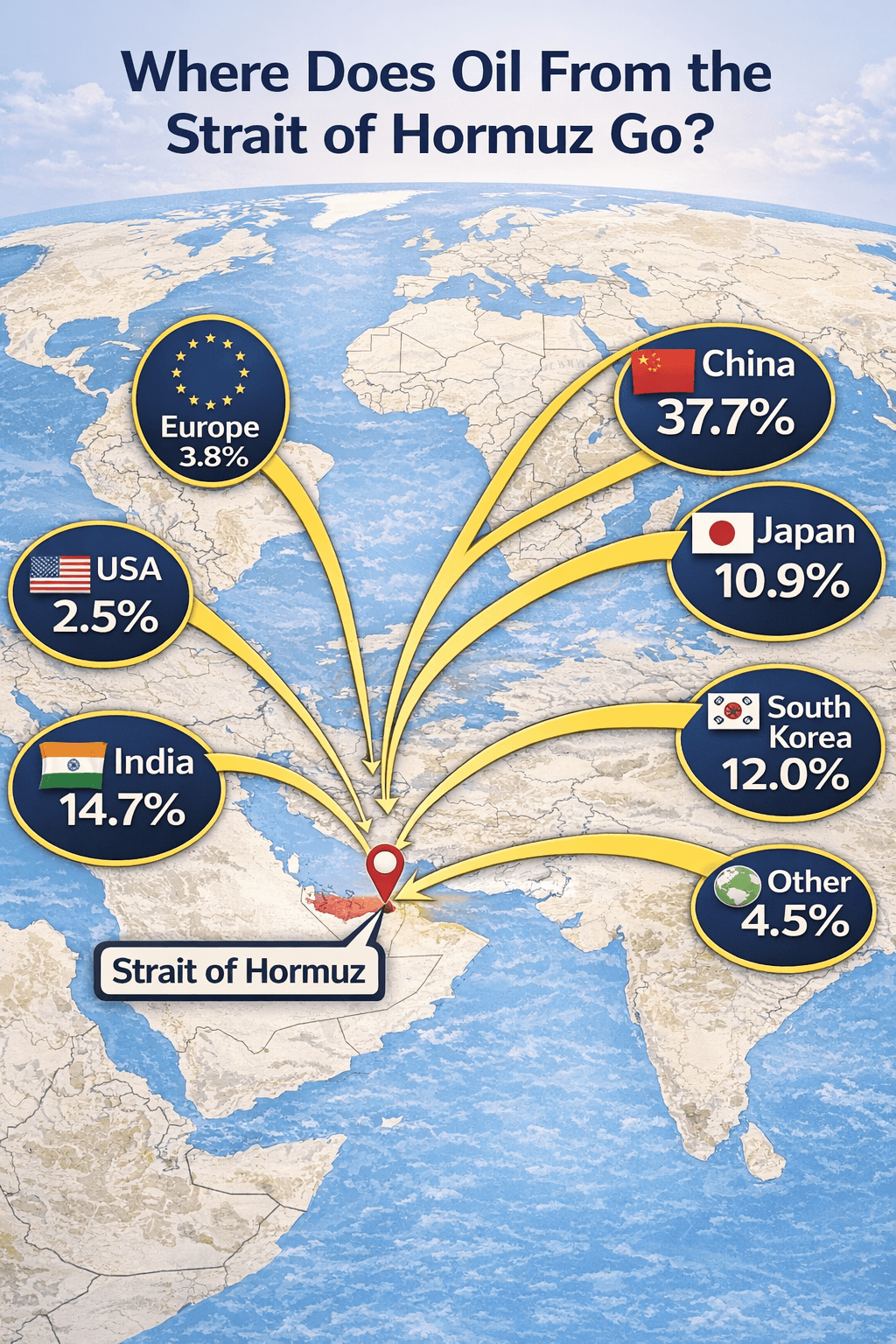
The global distribution of oil transported through the Strait of Hormuz, one of the world’s most critical energy chokepoints, and clearly shows that the vast majority flows to Asia. China receives the largest share at 37.7%, followed by India (14.7%), South Korea (12.0%), and Japan (10.9%), demonstrating Asia’s overwhelming dependence on this route. Smaller portions are directed to Europe (3.8%), the United States (2.5%), and other regions (4.5%), making up the remainder of global flows. Overall, the visualization underscores how this narrow strait plays a central role in supplying energy to the world’s largest economies, meaning any disruption here could have immediate and widespread effects on global oil markets.
Where Does LNG (Gas) From the Starit of Hormuz Go?
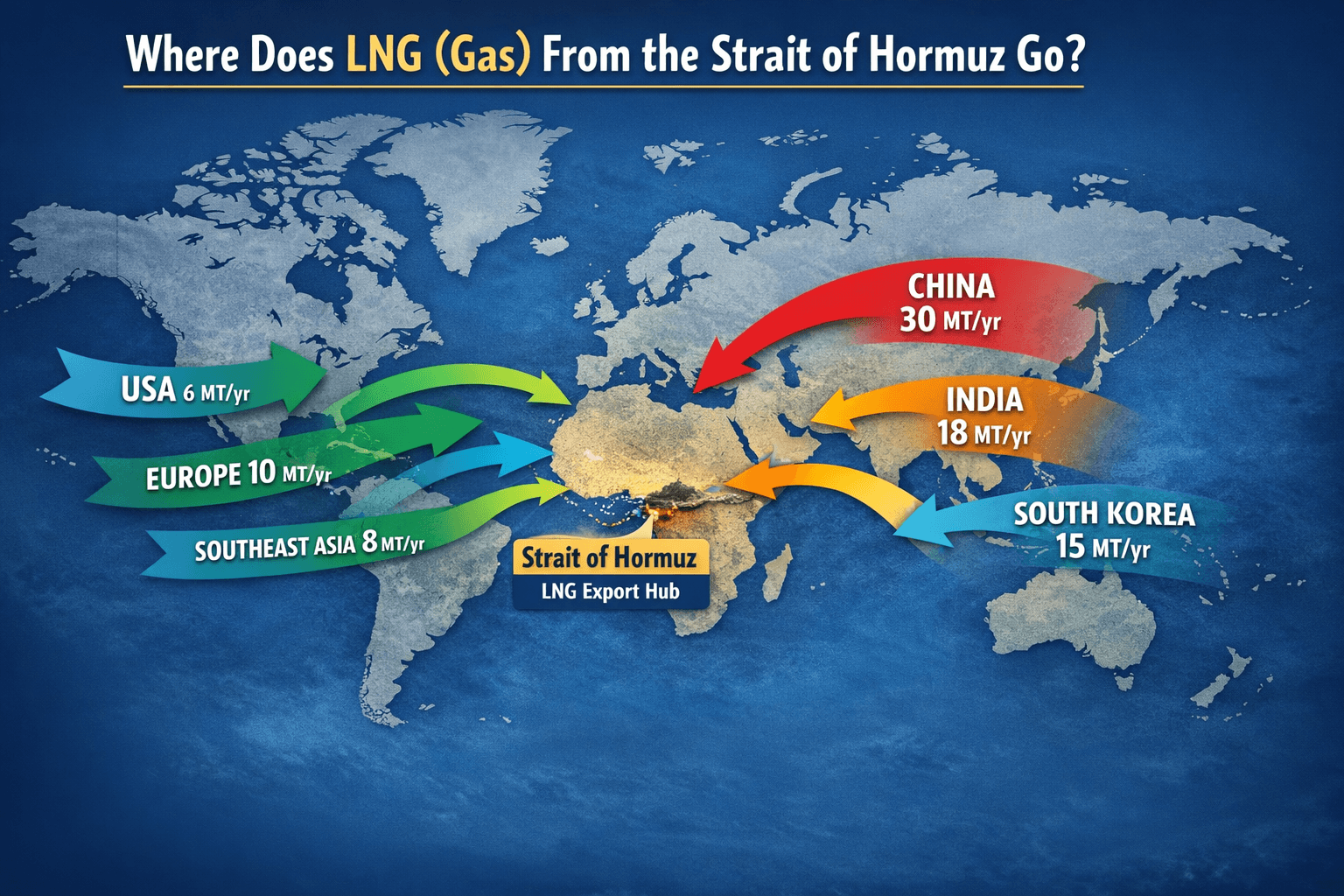
The global distribution of liquefied natural gas (LNG) exports from the Strait of Hormuz, showing how this critical energy corridor supplies major economies worldwide. The largest share flows to China (30 MT/yr), followed by Japan (20 MT/yr), India (18 MT/yr), and South Korea (15 MT/yr), highlighting Asia’s dominant role in LNG demand. Additional volumes are directed toward Europe (10 MT/yr), Southeast Asia (8 MT/yr), and the United States (6 MT/yr), demonstrating a broader but smaller distribution across other regions. Overall, the visualization emphasizes that the Strait of Hormuz is not only vital for oil but also a key global hub for LNG trade, where any disruption could significantly impact energy supply chains and international markets.
Strait of Hormuz – GLOBAL CRISIS (2026) | Global Oil and LNG at Risk | 4K
Watch this video directly on YouTube
Watch on YouTubeFor the best viewing experience, watch the full video on the World Guide YouTube channel at youtube.com/@WorldGuide.
Why is the Strait of Hormuz Important Right Now?
The Strait of Hormuz is crucial today because it carries a large share of global oil shipments, making it highly sensitive to geopolitical tensions.What Happens if the Strait of Hormuz Closes?
If the Strait of Hormuz closes, global oil supply would be severely disrupted, causing sharp increases in energy prices and economic instability.Strait of Hormuz Crisis Explained (Simple Guide)
The Strait of Hormuz crisis refers to ongoing tensions and potential conflicts that threaten the safe passage of oil through this critical waterway.Who Controls the Strait of Hormuz?
The Strait of Hormuz is bordered and influenced primarily by Iran and Oman, but international naval forces also play a role in maintaining security.Why Does the Strait of Hormuz Matter for Oil Prices?
The Strait of Hormuz directly affects oil prices because any disruption in this key transit route can limit global supply and increase costs.How Much Oil Passes Through the Strait of Hormuz?
Approximately one-fifth of the world’s oil supply passes through the Strait of Hormuz each day, making it a vital global energy corridor.Why is the Strait of Hormuz the World’s Most Important Oil Route?
It is considered the most important oil route because it connects major oil-producing countries in the Gulf to global markets.The Most Dangerous Waterway in the World?
The Strait of Hormuz is often called the most dangerous waterway due to its strategic importance and frequent geopolitical tensions.Why One Narrow Strait Controls Global Oil?
This narrow strait controls global oil flow because it is the primary export route for major Middle Eastern oil producers.Top 5 Most Important Chokepoints in the World (include Hormuz)
The world’s key chokepoints include the Strait of Hormuz, Suez Canal, Panama Canal, Strait of Malacca, and Bab el-Mandeb, all critical for global trade and energy supply.What Time Is It in Strait of Hormuz Right Now?
Where is located Strait of Hormuz on the Google Map?
Feel free to explore these pages as well:
- Kharg Island Map ↗️
- Where is Kharg Island ↗️
- Strait of Hormuz Map ↗️
- Where is Strait of Hormuz ↗️
- Where Oil and LNG (Gas) from the Strait of Hormuz Go ↗️
- Strait of Hormuz Crisis ↗️
- Strait of Hormuz – GLOBAL CRISIS 2026 ↗️
- Iran Map ↗️
- Iran High-resolution Map ↗️
- Where is Iran ↗️
- Iran Political Map ↗️
- Iran Physical Map ↗️
- Iran Ethnic-groups Map ↗️
- Iran Cities Map ↗️
- Iran Regions Map ↗️
- US and Israeli strikes on Iran in maps ↗️
- Israel High-resolution Map ↗️
- Iraq High-resolution Map ↗️
- Iran Time-zone Map ↗️
- Iran Israel War Map – Location Strikes Map in Iran and Israel ↗️
- Israel Map ↗️
- Saudi Arabia Map ↗️
- Where is Located Qatar in the World? ↗️

